How a home loan decision is made, one step at a time
In brief
AI is good at reading messy documents and poor at applying the same rule the same way twice, and a lender needs both. This worked example splits a home loan decision into three steps: code and an AI reader copy the figures from the documents, a typed decision model answers a few narrow judgement questions and says how sure it is, and rule tables written in The Decision Model decide. Every outcome can be explained to the applicant and checked by an auditor. The example below is interactive, and all applicants and figures are invented.
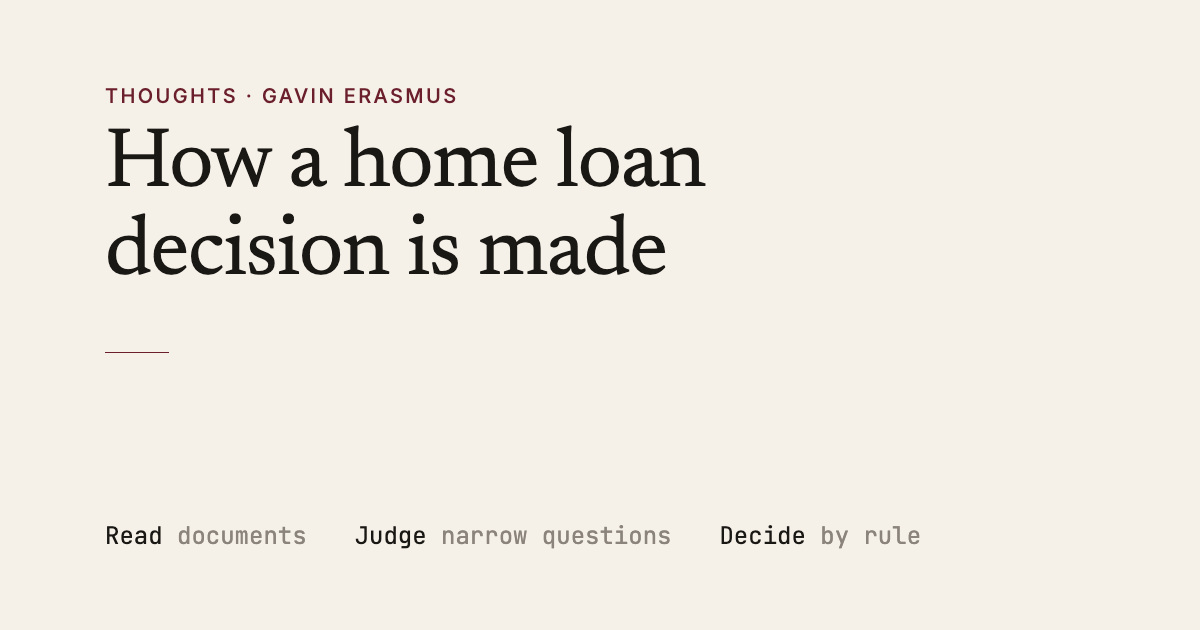
A lender needs two things that AI does not offer together: it must read messy documents, and it must apply the same rule the same way every time. AI is good at the first and poor at the second. The answer is to split the job into three steps, so that each decision can be explained to the applicant and checked by an auditor. Code and an AI reader copy the figures from the documents, a typed decision model answers a few narrow judgement questions and says how sure it is, and rule tables decide.
This post works through a home loan application in that shape. The interactive example below lets you change the applicant and watch each step respond. The applicants, figures and rules are invented for illustration.
Why split the job this way
If you ask one AI model to read the documents and make the decision, it may weigh things differently tomorrow, and nobody can point to the rule it used. Splitting the work keeps each part honest. The reader copies facts that are printed on the documents and decides nothing. The judgement model answers narrow questions from a fixed list and admits when it is unsure. The rules decide, the same way every time, in tables a credit manager can read and sign off.
The rule tables follow The Decision Model (TDM), a method published by Barbara von Halle and Larry Goldberg in 2009. The same pattern, applied to finance workflows, is set out in Applying The Decision Model to long-running agent workflows. The wider method for putting agents into a business, with named people approving what matters, is described on the Approach page.
Let the AI read and advise. Let the rules decide. Let a person settle anything unclear.
Three applicants to try
Thandi has a steady salary and a clean record, so the model approves. Pieter's budget is stretched, so the repayments take too large a share of his pay. Lerato is a new freelancer, so the AI is not sure her income is a regular salary, and the system refers her to a person rather than guessing. Move the sliders to find the edges: lower the AI's confidence below 80 per cent, or raise the loan until the affordability table changes its conclusion.
Worked example · Decision modelling
Try it: how a home loan decision is made, one step at a time
Choose an applicant or move the sliders in step 0 and watch each step update. The applicant, figures and rules are invented for illustration.
The application
What the applicant handed in: a payslip, three months of bank statements, an employment letter and a credit bureau report.
Read the documents
Done by code and an AI reader. It only copies figures that are printed on the documents. It does not decide anything.
Answer the judgement questions
Done by a typed decision model (here, one called Jev). It answers only a few fixed questions, and it says how sure it is. Below 80% sure, its answer counts as “not sure” and a person looks at it.
Apply the lending rules with a decision model
Done by rule tables written in The Decision Model (TDM) format. They run in code and give the same answer every time.
TDM writes a decision down as a small set of tables instead of a page of prose. Four ideas are enough to read it:
The decision model for this loan
Where every input comes from
| Input (fact type) | Comes from | This applicant | Used in |
|---|---|---|---|
| Credit score | Document Bureau report | 705 | Credit record |
| Missed payments, 12 months | Document Bureau report | 0 | Credit record |
| Months in current job | Document Employment letter | 48 | Income reliability |
| Repayment share of pay | Calculated (new instalment R 13 546 + existing debt) ÷ take-home pay | 29% | Affordability |
| Money left each month | Calculated Take-home pay − expenses − all repayments | R 22 954 | Affordability |
| Regular salary? | AI answer Jev, step 2 | Yes | Income reliability |
| Hidden debt? | AI answer Jev, step 2 | No | Income reliability |
| Affordability | Rule result Rule family 1 | Affordable | Lending decision |
| Credit record | Rule result Rule family 2 | Good | Lending decision |
| Income reliability | Rule result Rule family 3 | Reliable | Lending decision |
Source key: Document copied in step 1 · Calculated from document figures · AI answer from step 2 · Rule result from another table.
The rule families
| Repayment share of pay Calculated | Money left each month Calculated | Affordability Conclusion |
|---|---|---|
| 30% or less | R 0 or more | Affordable |
| 31% to 36% | R 0 or more | Stretched |
| Over 36%, or | less than R 0 | Not affordable |
| Credit score Document | Missed payments, 12 months Document | Credit record Conclusion |
|---|---|---|
| 680 or more | None | Good |
| 600 or more | 1 at most | Fair |
| Below 600, or | 2 or more | Poor |
| Regular salary and no hidden debt? AI answer | Months in current job Document | Income reliability Conclusion |
|---|---|---|
| Yes | 6 or more | Reliable |
| Yes | Fewer than 6 | Unproven |
| “Not sure” on any step 2 question | Any | Unknown |
| Affordability Rule result | Credit record Rule result | Income reliability Rule result | Lending decision Conclusion |
|---|---|---|---|
| Any | Any | Unknown | Refer to a person |
| Not affordable, or | Poor | Any | Decline |
| Affordable | Good | Reliable | Approve |
| Any other combination | Refer to a person |
The decision, with its reasons
Every outcome can be traced back to a row in a table and a figure on a document.
Outcome
Approve
The repayments fit the budget, the credit record is clean and the salary is regular.
Affordability: Affordable → Credit record: Good → Income reliability: Reliable → Approve
The rule tables follow The Decision Model, a method published by Barbara von Halle and Larry Goldberg (2009), applied here to AI agents. This example is an illustration only. It is not a lending policy or credit advice; a South African lender must also meet the National Credit Act’s affordability assessment rules.
Questions and answers
Why not ask one AI model to read the documents and decide the loan?
A single model may weigh the same facts differently tomorrow, and nobody can point to the rule it used. Splitting the work keeps each part accountable: the reader copies figures, the judgement model answers narrow questions, and rule tables decide the same way every time.
What does the AI actually decide in this design?
It decides very little. It copies figures printed on the documents, and a typed decision model answers a few fixed questions, such as whether the income is a regular salary. Each answer carries a confidence score, and below 80 per cent the answer counts as not sure and a person looks at it.
What is The Decision Model?
The Decision Model (TDM) is a method for writing business logic as rule families, which are small tables of conditions and conclusions that chain together. It was published by Barbara von Halle and Larry Goldberg in 2009. The rule tables run in code and give the same answer for the same input.
Is this a lending policy?
No. The applicants, figures and rules are invented to illustrate the pattern. It is not credit advice, and a South African lender must also meet the National Credit Act's affordability assessment rules.
Reference
von Halle, B. and Goldberg, L. (2009). The Decision Model: A Business Logic Framework Linking Business and Technology. Auerbach Publications.
If you are considering where AI should read, advise and decide in a lending or approval process, I would welcome the conversation.
Get in touch