The Bottleneck Lens: Where Does Work Wait?
In brief
When we apply AI to enterprise workflows, we tend to focus on individual tasks. The real question isn't how to do the task faster. It's: where does the work wait? Using a corporate lending desk as the example, this piece walks through four places where work waits in large organisations (the intake queue, the missing information loop, the synthesis step and the approval gate) and how AI can unblock each one.
When I was working on an AI transformation programme in Saudi Arabia last year, we quickly realised that the process modelling already done had missed the detail of the decisions themselves: the diamonds on the process maps. To fix that, we developed a decision-mapping approach based on The Decision Model (TDM) and reworked the processes to get the most from AI decision-making and unblock the flow.
A recent article reminded me how much this matters. In "The search for the AI-native firm" (The Angle, issue #327, 17 November 2026), David Peterson of Angular Ventures argues that AI adoption will be fast but transformation slow. The first question he says any AI-native firm must answer is where the bottleneck is. Drawing on Goldratt's The Goal, he puts it plainly: "if you haven't addressed the bottleneck, you haven't increased output."
https://newsletter.angularventures.com/p/the-search-for-the-ai-native-firm
When we apply AI to enterprise workflows, we tend to focus on individual tasks. Can an LLM draft an email faster? Can it classify a document more accurately? The answer is often yes.
The real question isn't how to do the task faster. It's: where does the work wait?
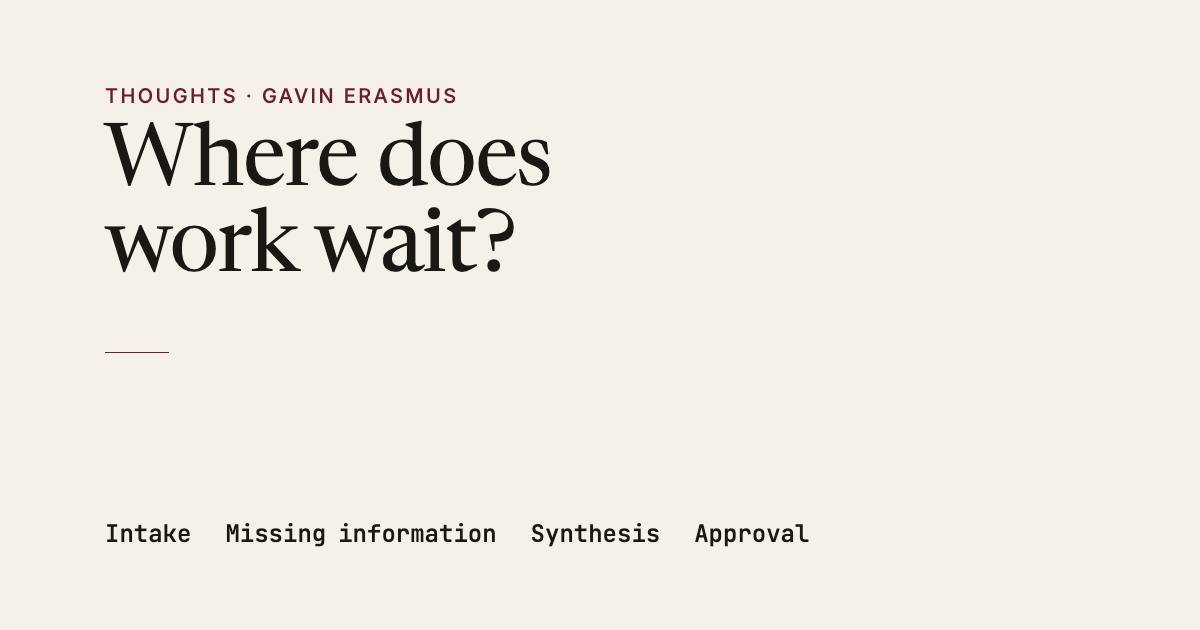
Here are four examples of where work actually waits in large organisations, and how AI can unblock them.
One: The Intake Queue
The first delay is often just understanding what is being asked. Consider a bank's corporate lending desk. A relationship manager sends an unstructured email with attached financials. A human has to read it, decide if it's a new loan, an amendment, or a query, and route it to the right team. Work waits because triage is manual. AI can classify and route these instantly, turning a 24-hour wait into seconds.
Two: The Missing Information Loop
The second delay is the back-and-forth. The lending team receives the request, but the covenant compliance certificate is missing from the attachment. They email the relationship manager back. Work waits. An AI agent, reading the same email at intake, can instantly detect the missing document and reply asking for it, preventing the task from even entering the human queue until it is ready to be worked.
Three: The Synthesis Step
The third delay is reading across documents to form a view. A credit analyst needs to read the financials, the covenant certificate, and the company's latest public filings to write a credit memo. Work waits while the analyst synthesises. An LLM can't write the final credit decision, but it can instantly extract the key metrics, flag discrepancies against the covenants, and draft the summary section.
Four: The Approval Gate
The final delay is waiting for a signature. A senior manager has to review the credit memo and approve the loan. Work waits in their inbox. While AI shouldn't make the final credit decision, it can pre-flight the approval: checking that all mandatory fields are complete, that the requested amount is within the manager's delegated authority, and that the summary matches the supporting documents. This means when the manager opens the request, they can approve it immediately, rather than sending it back for corrections.
AI adoption is fast because improving an individual task is easy. AI transformation is slow because the bottlenecks are usually in the handoffs, the synthesis, and the approvals.
If you are looking at your AI roadmap and only see task acceleration, you are missing the real prize. The AI-native firm won't just do tasks faster. It will eliminate the wait times entirely.
Are you mapping your processes to find the bottlenecks, or just accelerating the tasks within them?
Questions and answers
What is the bottleneck lens?
It replaces the question of how to do a task faster with a different one: where does the work wait? Drawing on Goldratt's The Goal, David Peterson of Angular Ventures puts it plainly: if you haven't addressed the bottleneck, you haven't increased output.
Where does work wait in a large organisation?
Four common places: the intake queue, where someone has to understand and route the request; the missing information loop, the back-and-forth when something is absent; the synthesis step, reading across documents to form a view; and the approval gate, waiting for a signature.
Should AI make the final decision at the approval gate?
No. AI shouldn't make the final credit decision. It can pre-flight the approval: checking that all mandatory fields are complete, that the requested amount is within the manager's delegated authority, and that the summary matches the supporting documents, so the manager can approve it immediately.
Why is AI adoption fast but transformation slow?
Adoption is fast because improving an individual task is easy. Transformation is slow because the bottlenecks are usually in the handoffs, the synthesis and the approvals.
If you are looking at your own processes to find where work waits, I would welcome the conversation.
Get in touch